If we take the set of -th roots of unity (with even) and square each element, the resulting set will be a set of half the size. The new set will be the -th roots of unity.
For example, suppose . The 6th roots of unity would be
If we square each element, we get the following set. Some elements have exponents greater than or equal to , but we will handle that in the next step.
We can then factor the exponents as follows:
Since is a 6-th root of unity, so we have:
Removing multiplication by , we get
Now replace all the duplicate terms with a single element:
The new set is half the size of the original, and each element is a 3-rd root of unity:
If we plot the 6-th roots of unity on a circle, we can see that squaring “removes” every other element. We started with and ended with
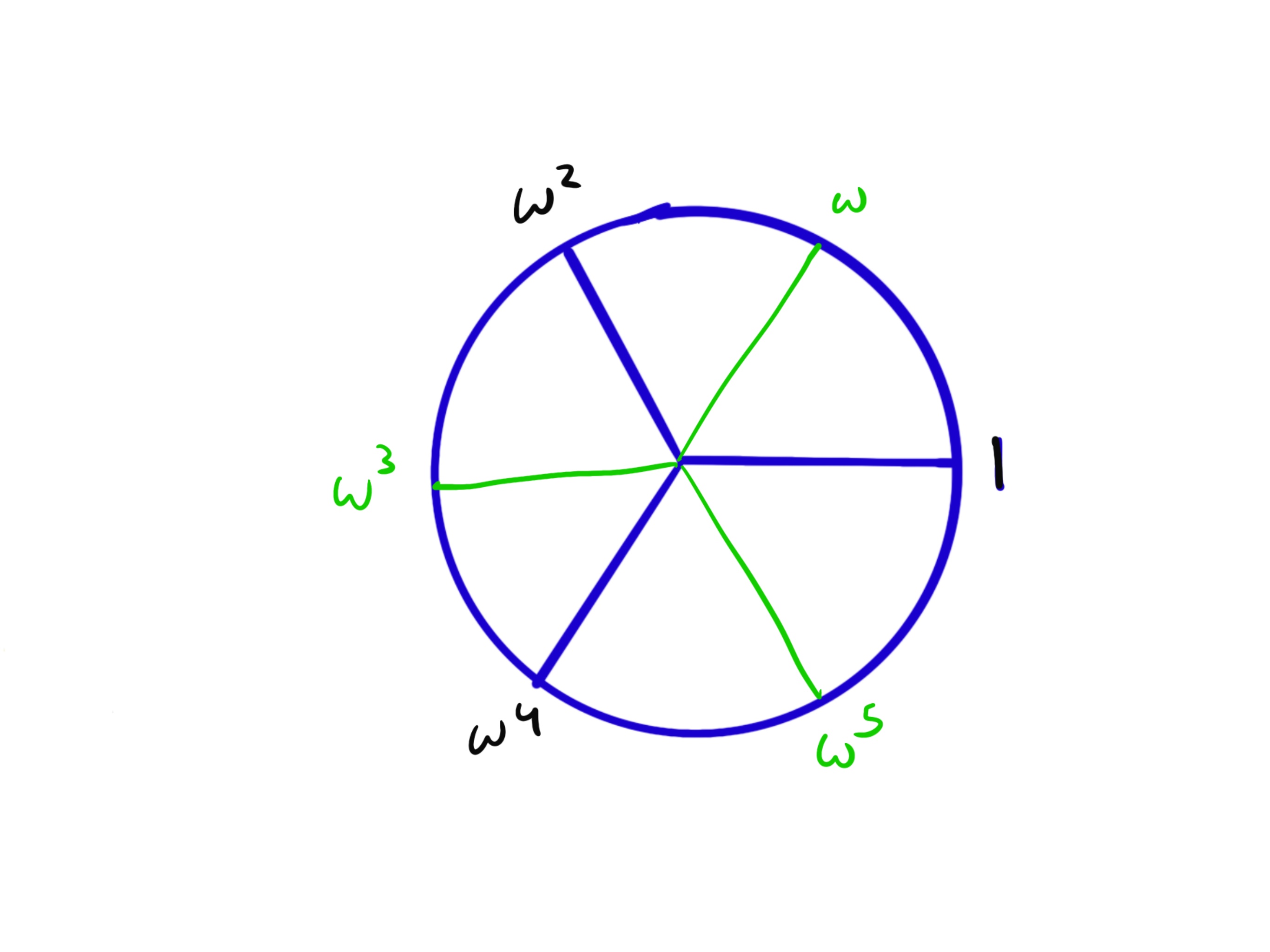
To reiterate, if we take the set of -th roots of unity, and is even, then square each element, we get a set of half the size with each element being the -th root of unity.
Some more examples:
- If and we square each of the 10-th roots of unity, we get a set of size five which are the fifth roots of unity.
- If and we square each of the 8-th roots of unity, we get a set of size four which is the fourth roots of unity.
- If and we square each of the 4-th roots of unity, we get a set of size two which is the 2-nd roots of unity.
- If and we square each of the 2-nd roots of unity, we get a set of size 1 which is just the element 1.
The last point is easily illustrated. The second roots of unity are square roots of 1, which are always . Squaring 1 results in 1 and squaring -1 results in 1. Equivalently, .
Example of squaring the 8-th roots of unity
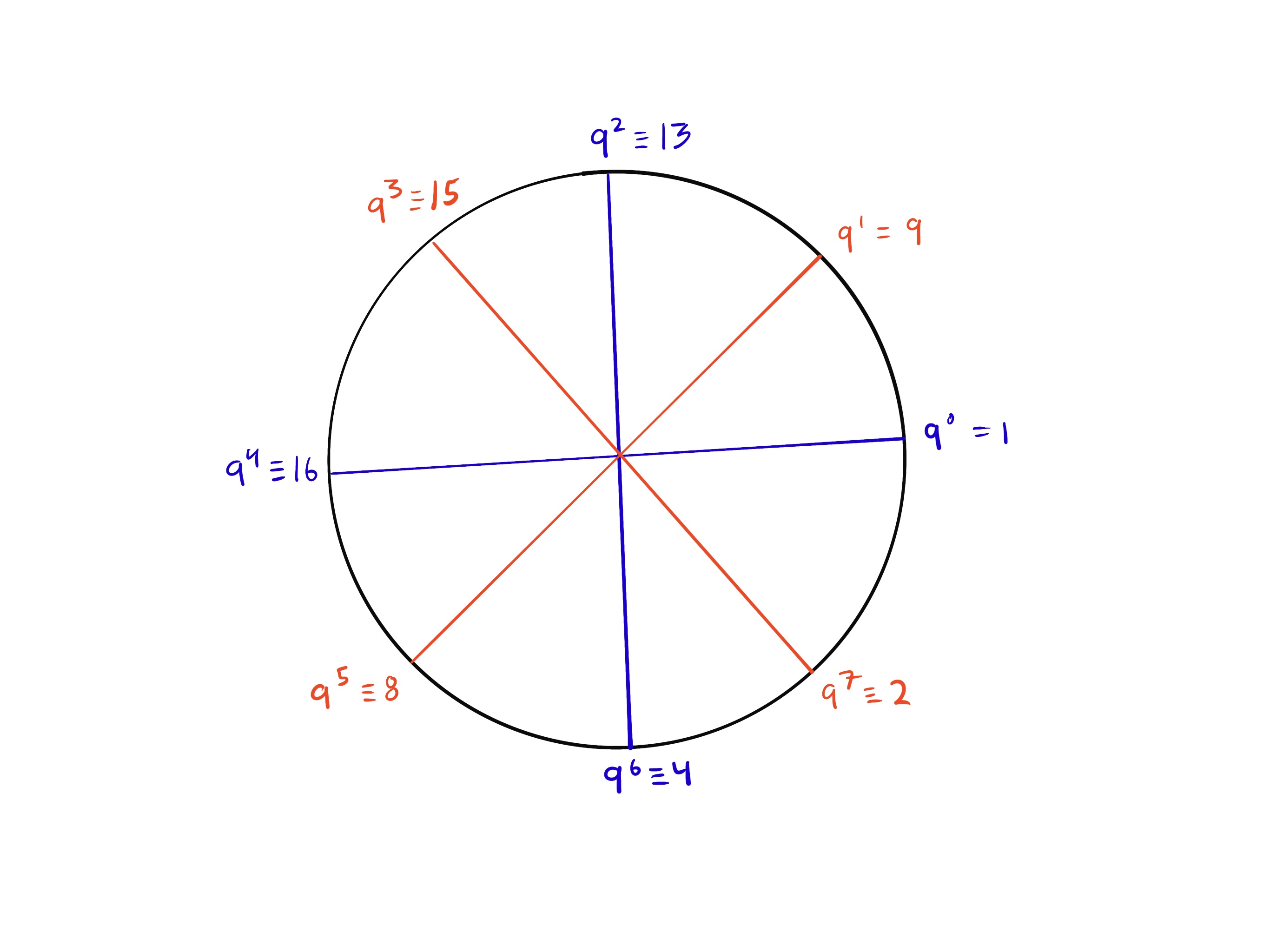
Consider the subgroup of 8th roots of unity in the finite field . We square all elements of this subgroup as follows:
The set obtained after squaring is , which is precisely the subgroup of 4th roots of unity.
Here is a visualization of the roots of unity before and after squaring. We started with the set and ended with the set
k must be even
If is odd, then there is no such thing as “half of the group” as an odd-sized set cannot be divided into two. For the purposes of NTT, we only deal with even-sized , so we aren’t interested in the case where is odd.
Proof of the claim that the new set is half the size
Let be a primitive -th root of unity with even. Let be the subgroup generated by of order . We claim that .
The proof is actually quite simple and intuitive.
We established in an earlier chapter that and are additive inverses. Since is even, we can partition the group into two sets, the first one being and the second being :
Those elements are congruent to the following representation:
If we apply to both sets, we get two sets with identical content and size
Since the two sets are identical, the union of the two sets will be the same size, which is .
Proof that squaring a -th root of unity produces a -th root of unity
Suppose is a -th root of unity. We aim to show that is a -th root of unity, that is:
Let’s simplify :
Since (because is a -th root of unity), it follows that .
Therefore, is indeed a -th root of unity.